My Story
About Me
My name is Morgan Manning. I was born in El Centro, California, in the summer of 1967.
I chose not to delve too much into my childhood as much of it was squeamish, however growing up, I had a pretty good life. I had a good mom, a so so dad, and I was pretty lucky in that way. But from the beginning, I was especially close to my mother. There was just something about her that I was drawn to.
My mother was incredibly creative. She was outgoing, social, artistic, and she had this way of making life interesting. I loved being around that energy, so wherever my mother was, chances were I wasn't too far behind. I was definitely a mama's boy. And I make absolutely no apology for it. My mother was a painter, and she eventually became a published and accomplished artist. Art was a huge part of our lives. During the summers, my mother would take us kids up to Idyllwild, California, to what was then the Idyllwild School of Music and the Arts. My brother and I would take different art classes, while my mother studied painting.
And this is where my childhood starts sounding a little unusual. One of my mother's painting teachers was Françoise Gilot. Françoise had been Picasso's partner for many years and was the mother of two of his children. She was an extraordinary artist in her own right, and she and my mother became very close friends. Years later, Françoise married Dr. Jonas Salk, the medical researcher who developed the first successful polio vaccine. So there I was, this kid from El Centro, spending summers in Idyllwild, and while my mother and Françoise were painting together, Jonas Salk and I would sometimes go swimming. At the time, I'm not sure I fully understood how unusual any of this was. It was just my life. We grew up around some fascinating people. There were celebrities, artists, musicians, interesting conversations, and creativity everywhere. We did fun things. We were exposed to things most kids probably weren't exposed to. Like vacationing on our beach front condo in Del Mar, CA., where we lived next door to Charles Bronson. Charles daughter and I were around the same age and we played together almost everyday. Mr. Bronson would take the Sunday morning papers and make paper airplanes out of them and take us up on the top floor to fly them off. He was a very sweet man, and my cousin actually ended up dating his son, who later passed away.
But here's the funny part. With all of that around me, I was absolutely terrible at school. I always say I was basically a seat warmer. I didn't do well in a traditional classroom. My mind simply didn't work the way the school system wanted it to work. I could come up with the right answer, but if I didn't arrive at it exactly the way the book told me to, somehow I was wrong. That drove me crazy. Eventually, I decided school wasn't for me, and I dropped out in the ninth grade. But I wasn't lazy. Far from it. I was entrepreneurial almost from the time I was a kid. My brain was constantly thinking about ideas, businesses, and ways to make something happen.
At 16 years old, I opened a disco for kids under the age of 18. And it exploded. We would have around 1,500 kids in the club in a single night. Think about that. I was 16 years old, I had dropped out of school, and suddenly I was running a nightclub packed with 1,500 teenagers and making real money. That experience taught me something very early in life: just because you don't succeed inside somebody else's system doesn't mean you can't succeed. Sometimes you just have to build your own system. And that's what I did. Over the years, I started and ran several very successful businesses. I made a lot of money when I was young, and I learned business by actually doing it—making decisions, taking risks, failing sometimes, getting back up, and figuring things out.
Meanwhile, music was becoming another huge part of my life. Now, my two favorite musical worlds made absolutely no sense together. On one side, I loved Van Halen. And then I discovered Frank Sinatra.
How do you go from Van Halen to Frank Sinatra? I have no idea. But I did. When Sinatra's recording of "New York, New York" became popular, something about it grabbed me. I started listening to more of his music, and before long I became fascinated by the man himself—his phrasing, his breathing, his timing, his confidence, the way he could tell a story through a song. I studied him. I remember the first time I went to see Sinatra perform. He was appearing at the amphitheater in Orange County. And of course, I wasn't just going to show up in jeans. I put on a tuxedo. I got some friends together. And we took a limousine. When we arrived, I gave the limousine driver one of our Sinatra tickets as his tip and told him to come inside with us. So he did. And all of us went in together and had a fantastic night. That first concert turned into another one. And another one. And another one. By the time it was all over, I had seen Frank Sinatra perform about 36 times. Thirty-six times.
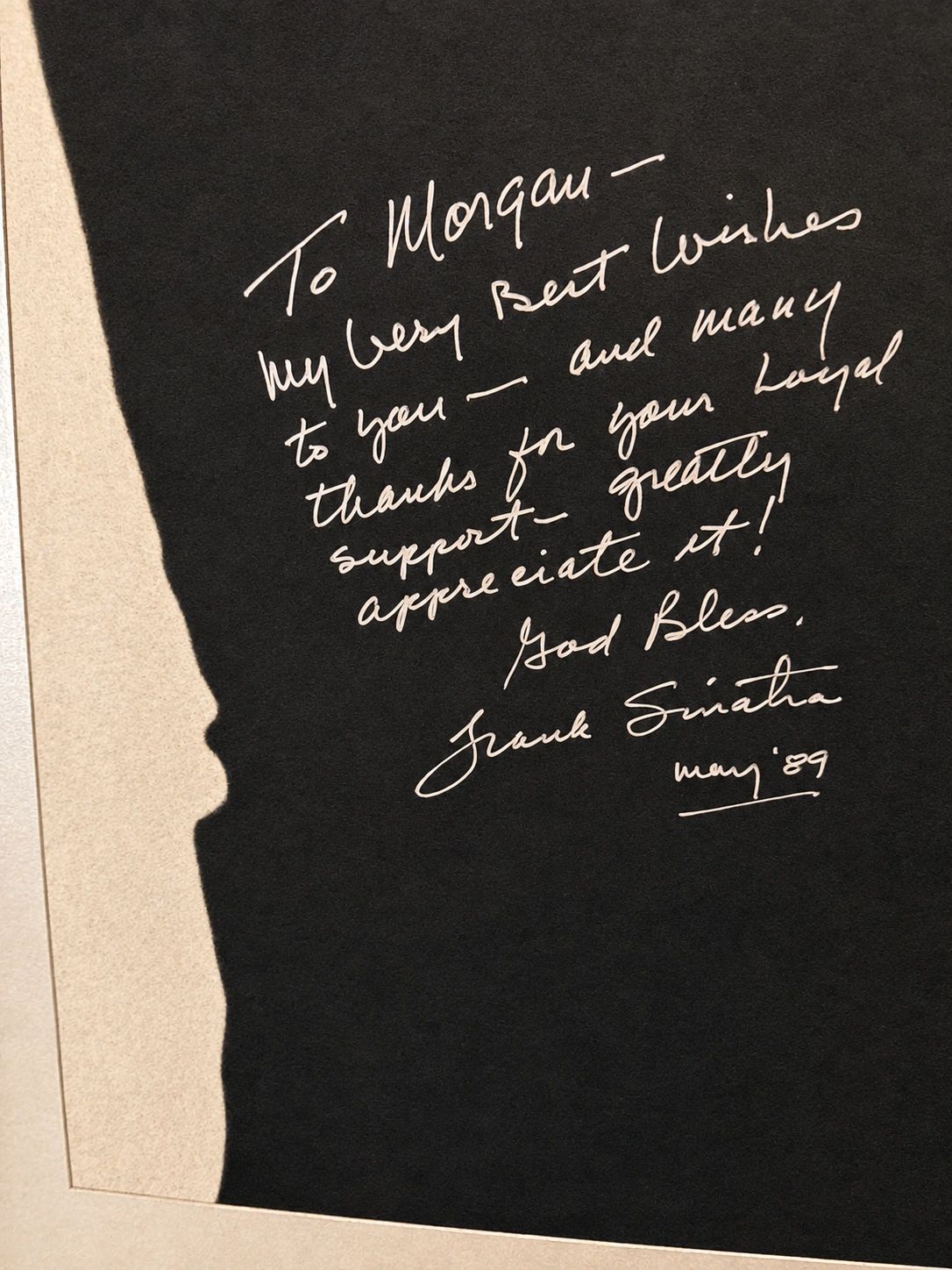
I became completely absorbed in that music. I started singing myself, studying Sinatra's techniques and trying to understand what made him so extraordinary. Back then, of course, there were no smartphones where you could just record yourself anytime you wanted. There were cassette tapes. So I would record myself singing and pass the tapes around. Over the years, because I had seen Sinatra perform so many times, I eventually got to know his assistant. That opened up an entirely different world for me. I began receiving invitations to parties and events around Palm Springs. I met people from Sinatra's circle and accumulated some wonderful Sinatra memorabilia, including signed pieces. It seemed like somehow, everywhere I went, another connection to Frank Sinatra appeared.
Then one day, I decided to give Sinatra a cassette tape of me singing. I really didn't know what, if anything, would happen. The next day, my phone rang. It was Dorothy Ulhman, Frank Sinatra's personal assistant. She asked me a question. "Do you sing professionally?" I told her no. Then she told me something I never expected to hear. Frank Sinatra had listened to my tape. And he thought I should. She told me that when I did begin singing professionally, Sinatra wanted to come see me perform.
Suddenly, this thing I had been doing because I loved it became very real. And here's what's funny. Everybody had always thought I was going to become a comedian. I've always had a wicked sense of humor. Growing up, some of my idols weren't singers at all. They were Steve Martin, Soupy Sales, Flip Wilson, and Jerry Lewis. Years later, I even took a course from Jerry Lewis in San Diego called Healing With Laughter. So if you'd asked the people around me what Morgan Manning was going to do with his life, I'm pretty sure "singer" wouldn't have been their first answer. But that's exactly what happened. And once the singing started, things began moving very quickly.
Suddenly, I was getting invitations to perform at places like the Venetian in Las Vegas, the Golden Nugget, events for the World Research Foundation, and a number of other shows. Then something happened in Las Vegas that I'll never forget. I was staying at the Golden Nugget and had given one of my tapes to a producer. Remember, this was before you could send somebody a link and say, "Here, listen to me." You handed them a cassette tape and hoped they actually played it. Not long afterward, I was paged. I walked over to a pay phone and picked it up. It was the producer. He told me he'd been listening to my tape in his car and had actually pulled over so he could call me. He said he was flabbergasted by my voice. Then he asked me a question that changed things: "When can you move to Las Vegas?" So eventually, that's exactly what I did. I moved to Las Vegas and stayed for about a year.
I began working with a vocal coach who had trained established old-school singers, including Vic Damone. For somebody who had grown up studying Sinatra, I was suddenly getting very close to the world I had spent years admiring. There was even a plan to prepare me to perform nightly at the Riviera Hotel. On paper, it sounded like everything I should have wanted. There was only one problem. I was miserable. Las Vegas just wasn't my city. I was lonely. I didn't like living there. The crime bothered me, and more than anything, I became terribly homesick. So I did something that probably made absolutely no sense to the people around me. I turned down the opportunity at the Riviera. And I went home. My singing career didn't stop, though. If anything, it continued to grow.
Eventually, I received a call from someone at Universal Records who had heard one of my tapes. He wanted to meet me, so I went up to Universal and sat down with him. He told me he wanted to work with me personally. He wanted to manage me. Once again, here was this door opening right in front of me—the kind of door singers spend their entire lives trying to get through. And once again, something inside of me pulled back. I've never completely understood it. There was always a part of me that loved singing but didn't want to surrender my entire life to show business. I started missing appointments. I didn't follow through the way I should have. Eventually, the opportunity disappeared. Looking back, maybe some part of me already knew there was something else I was supposed to do. I just didn't know what it was yet.
Buddy Greco
Then I heard about Buddy Greco. Buddy was an extraordinary pianist and singer from that great era of entertainers I loved. The head of entertainment at the Golden Nugget knew about me and contacted Buddy, telling him he should meet me. Buddy was performing in Palm Springs, so after one of his shows, I waited outside. When he came out, we met and talked for quite a while. It was a wonderful conversation, but I assumed that was probably the end of it. A few weeks later, I went to a show at the McCallum Theatre in Palm Desert. They showed me to my seat. 6 And who walks up and sits down right beside me? Buddy Greco. Of all the seats in that theater, he ends up sitting next to me. We started talking again. Buddy told me he'd recently opened a club in Cathedral City and invited me to come by the following evening. So I did. I had dinner, watched him perform, and afterward we sat and talked. That night became the beginning of a friendship that lasted more than 15 years. And Buddy wasn't just somebody I occasionally ran into. He became a real friend.
On my 40th birthday, Buddy actually canceled a concert so he could bring his band to my house and perform in my living room. And because apparently having Buddy Greco perform in my living room wasn't crazy enough, I put one ticket to my birthday party on eBay for $1,500. Somebody bought it. The man flew all the way from Ohio to attend my birthday party. I had close to 200 people there that night, and Buddy Greco and his band performed for about two hours. After Buddy finished, I got up and sang. I ended up doing about a two-hour set myself. Buddy sat there and watched me. The next morning, my phone rang. It was Buddy. He told me, "That was amazing." Then he said he wanted me to come over that morning and rehearse with him because he wanted me to perform at his show that night. So I went over. We rehearsed. That evening, Buddy was performing his concert when, in the middle of the show, he called me out of the audience. I walked onto the stage and sang two songs with him. Afterward, we had dinner together. That's when Buddy told me something I'll never forget. He said he wanted to produce me. He told me I should be making records. He believed singing was my calling. Coming from Buddy Greco, that meant an enormous amount to me. But as important as Buddy became to my musical life, what he eventually did for me personally meant even more.
When Everything Changed Years later, my life became very different. My mother was becoming seriously ill with Alzheimer's and Parkinson's disease. At the same time, I went through one of the hardest periods of my own life. I lost my home. I lost my car. And while everything around me seemed to be falling apart, I was trying to take care of my mother. Buddy saw what was happening. And he stepped in. He loaned me his car. He paid movers to move my mother and me into another home. He put up the money we needed to get into that house. Then one day he called me into a room and handed me $1,000. And he told me something else: "Every night, I want you and your mother to come to the club and eat. That way, you have food." So that's what we did. Every night, I would take my mother to Buddy's club. We would have a wonderful dinner. We'd sit there together and watch Buddy Greco perform. Then I'd take Mom home. For a little while, in the middle of an incredibly difficult time, we had that. But my mother's condition was getting worse. And then she began declining very rapidly.
Eventually, I reached the point where I had to make a decision about what my life was going to be. I had spent years singing. I'd performed in incredible places. I'd been invited into a world most people only dream about. Frank Sinatra had heard my voice and encouraged me to sing professionally. Universal Records had come calling. Buddy Greco wanted to produce me and told me that singing was my calling. But now my mother needed me. And when the moment came to choose, I didn't hesitate. Not for a second. I chose my mother. I gave it all up. I stopped pursuing the career. I stopped performing. In fact, I never sang again. Instead, I went home and became my mother's caregiver. At the time, I thought I was giving up one life to take care of her. I didn't realize I was about to begin the most important chapter of my life. And that is where my caregiving story begins.
Videos / STILL IN THE WORKS
World Research Foundation Performance. Sedona, AZ
Notice Lainie Kazan, Diane Ladd and others in the background. This was during a World Research Foundation fundraiser.
Live at the Venetian in Las Vegas, NV.
During the Rainbow Connection finals Halftime in Las Vegas, NV.
"After the Lovin'" Sung by Morgan Manning
Recorded session of Morgan Manning singing, "After the Lovin'".
(LISTEN TO VOICEMAIL BELOW FROM BUDDY GRECO)
Buddy Greco Voicemail
I had given a CD to Buddy Greco of me singing, "After the Lovin", (The exact same recording as above). This was his voicemail to me after listening to it.
Morgan Singing with Buddy Greco
The night after my 40th Birthday party, me singing with Buddy after he called me on stage.

My Pride and Joy!
Poster Sinatra had signed for me in Las Vegas.
Various Snapshots from Frank Sinatra Parties (Swipe <)





Copyright © 2026 Morgan Manning - All Rights Reserved.
Powered by ManningBot
This website uses cookies.
We use cookies to analyze website traffic and optimize your website experience. By accepting our use of cookies, your data will be aggregated with all other user data.